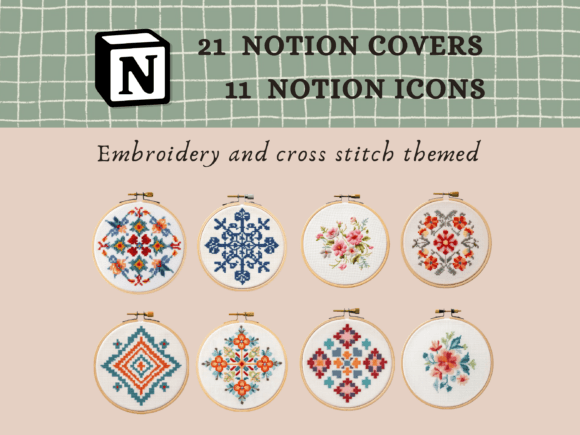
Embroidery and Cross Stitch Notion Icons
A Designer’s First Impression: Friendly, Handmade, and Thoughtfully Niche
As an embroidery designer who’s digitized over 2,000 commercial projects—from café aprons to boutique tote bags—I opened Embroidery and Cross Stitch Notion Icons expecting charm, not clutter. The title alone signals intention: this isn’t generic clipart. It’s purpose-built for planners, makers, and small business owners who stitch *and* organize. The description—“to enhance the aesthetic look of your unique Notion space, embroidery planner and cross stitch planner”—immediately tells me these icons lean into warmth, craft-conscious minimalism, and quiet confidence. They feel handmade but polished, playful but professional—not too cutesy, not overly rigid. That balance is gold for brands that sell tangible goods with soul: bakeries, florists, indie studios, pet boutiques, and local creative shops.
Real-World Business Use: Where These Icons Shine (and Where They Need Care)
Embroidery and Cross Stitch Notion Icons works best when treated as a subtle brand accent—not a primary logo, but a trusted supporting element. Think chest patches on staff aprons at a ceramic studio, sleeve details on custom work shirts for a floral design team, or minimalist cap fronts for a cross-stitch supply shop. On tote bags, they add quiet credibility: a tiny needle-and-thread icon beside a boutique name says “we make things by hand” without shouting it. For Etsy sellers, these icons become versatile design assets: layered into printable mockups, stitched onto product labels, or embroidered directly onto packaging tags for handmade soap or yarn kits.
They also hold up well in multi-use scenarios. A café might use one icon as a patch on barista aprons, another as a cap embroidery on weekend pop-up events, and a third resized as a subtle tote bag design for customer loyalty gifts. Because they’re rooted in craft symbolism—not fleeting trends—they support long-term brand identity consistency across merch lines.
Critical Considerations for Embroidered Production
Not all icons translate equally to thread. As a working embroiderer, I always test Embroidery and Cross Stitch Notion Icons in black and white first—no color assumptions. Small patch sizes (under 2 inches wide) demand ruthless simplification: fine outlines, tight spacing, or delicate cross-stitch motifs may vanish or blur under stitching. Cap fronts? Prioritize bold silhouettes over intricate detail. Curved surfaces like baseball caps or rounded tote handles exaggerate distortion—so I verify how each icon holds shape at target size before digitizing.
Fabric matters deeply. On textured linen aprons or heavy canvas totes, high stitch density can stiffen the design unnaturally. On dark uniforms, low-contrast thread colors disappear—so I match icons to base fabric tone early. And for items facing frequent washing (staff aprons, reusable totes), I avoid ultra-fine linework or floating elements that risk fraying over time. If the original digital embroidery file includes dense fill areas or overlapping stitches, I’ll manually adjust underlay and pull compensation—especially before running production batches.
How This Design Strengthens Your Small Business Brand
Used intentionally, Embroidery and Cross Stitch Notion Icons quietly elevates perceived value. A bakery that adds a subtle whisk-and-stitch icon to its delivery tote doesn’t just advertise—it invites customers into its process. That builds customer trust and buyer engagement. For handmade brands, these icons reinforce authenticity: no stock vector vibe, just thoughtful, craft-aligned visuals. When repeated across uniforms, packaging, and digital mockups, they create visual rhythm—strengthening brand recognition without repetition fatigue.
Importantly, they signal attention to detail. A florist using a clean, balanced needle icon on staff caps communicates care—not just in arrangements, but in presentation. That professionalism translates directly to perceived product quality and service reliability. And because they’re designed for planners and makers, they resonate emotionally with your ideal audience: organized, intentional buyers who value both function and beauty.
Practical Notes Every Embroidery Designer Should Apply
- Test at final size first: Resize the Embroidery and Cross Stitch Notion Icons graphic to your target patch dimensions (e.g., 1.5" wide) and zoom in—check spacing, legibility, and stroke weight.
- Confirm hoop size compatibility: Some icons may extend beyond standard 4x4 hoops if grouped or layered—verify before digitizing.
- Use proper stabilizer: Lightweight tear-away works for smooth cotton totes; cut-away is essential for knits or textured fabrics like denim or burlap.
- Inspect fabric interaction: Run a sample on your actual garment fabric—not just stabilizer swatches—to assess drape, sheen, and stitch definition.
- Create a client-ready mockup: Pair the icon with your brand’s typography and color palette in a printable mockup before approving final embroidered patch production.
- Compare alongside other design assets: Does it harmonize with your logo, packaging, and social visuals—or compete with them?
- Verify commercial licensing: Since this is a Graphics product intended for planners, confirm whether the license explicitly permits use on physical small business merch, custom apparel, and resale items before launching.
Final Thought: A Quiet Tool With Real Business Weight
Embroidery and Cross Stitch Notion Icons isn’t flashy—but neither is great branding. It’s the kind of asset that earns respect over time: stitched onto an apron worn daily, seen on a tote carried through farmers’ markets, or noticed on a cap at a craft fair. For small businesses building authentic connections through handmade product and thoughtful presentation, these icons aren’t decoration. They’re shorthand for care, craft, and consistency—and that’s exactly what makes them commercially valuable.