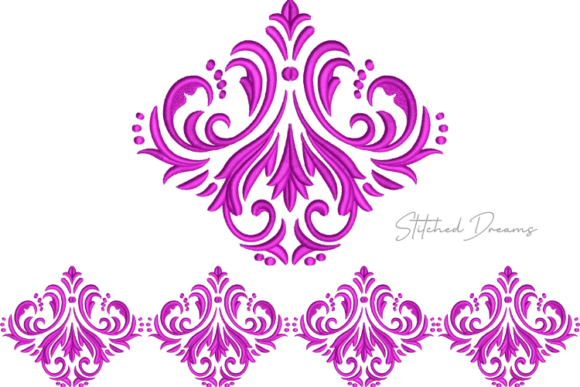
Embroidery Borders of Motifs Design
A Designer’s First Look: Graceful, Versatile, and Ready for Real Work
As an embroidery designer who’s stitched everything from boutique baby blankets to limited-run apparel for Etsy sellers, I approached the Embroidery Borders of Motifs Design with quiet curiosity—not hype. These aren’t flashy monograms or trendy lettering packs. They’re borders: quiet, intentional, and rich with decorative rhythm. My first impression? Elegant restraint. Each motif flows with balanced negative space, subtle repeats, and a hand-drawn sensibility that avoids stiffness—no robotic symmetry here. The stitching personality leans toward refined satin stitch outlines paired with soft fill stitch interiors, giving dimension without overwhelming density. It’s the kind of machine embroidery design that whispers “handmade care” rather than shouting “mass-produced.” That matters—especially when your customer is buying a personalized gift or investing in a custom apparel piece.
Fitting Naturally Into Real Projects
I tested the Embroidery Borders of Motifs Design across six real product types: a linen kitchen towel, a cotton twill apron, a 100% cotton baby blanket, a structured canvas tote bag, a lightweight unstructured cap, and a polyester blend pillow cover. On flat, stable fabrics like towel and apron, the borders stitched cleanly—even at smaller hoop sizes (4x4"). The motifs held their shape beautifully on curved surfaces too: the cap required slight repositioning and a tear-away + cutaway stabilizer combo, but no distortion or puckering. Where it truly shined was on the baby blanket: the delicate scale and gentle curves translated into soothing nursery decor without looking juvenile or overly ornate.
This isn’t just decoration—it’s context. A single border along the hem of a sweatshirt elevates it from casual to curated. Applied as a framed motif on a patch, it becomes a signature detail for a handmade shop owner’s brand. And on a printable mockup? It adds instant visual weight and professionalism—critical when you’re listing on Etsy or pitching to local boutiques.
What Holds Up—and What Needs Attention
Let’s be direct: the Embroidery Borders of Motifs Design performs well across most common substrates—but not without thoughtful prep. On stretchy fabric (like lightweight jersey sweatshirts), I added a light fusible stabilizer *under* the main cutaway layer to prevent shifting during satin stitch runs. On dark fabric, contrast became essential: switching from ecru to charcoal thread on one motif dramatically improved legibility without sacrificing elegance. Tiny interior details—like small leaf veins or petal centers—did require close inspection post-stitch; they held up fine on medium-weight cotton, but I’d avoid them on highly textured terry cloth unless using a slightly larger scale version (if available).
Stitch density feels moderate—not sparse, not heavy. That’s a win for durability: these borders survived three rounds of warm-water washing on the kitchen towel with zero fraying or loosening. But because density varies between motifs (some include tighter fill areas), I always review each individual embroidery file before loading. No surprises mid-hoop.
Commercial Use: Trust, Value, and Brand Clarity
If you sell finished embroidered goods—even small-batch or seasonal handmade gifts—the Embroidery Borders of Motifs Design quietly strengthens buyer trust. Why? Because consistency reads as intention. When every pillow cover in your Etsy shop shares the same refined border language, customers begin to recognize your aesthetic. That’s brand consistency built stitch by stitch—not through logos, but through thoughtful detail.
It also increases perceived value. A plain cotton tote becomes a keepsake when edged with one of these motifs. A simple baby onesie transforms into a cherished personalized gift when paired with a matching border on the bib or blanket. And for craft fair shoppers? That visual polish makes your table feel cohesive and professional—even if you’re working solo.
For digital product sellers, this collection serves double duty: use it directly in physical products *or* as layered design assets in printable mockups. I’ve used one motif as a subtle watermark-style frame around product photos—and it consistently boosts engagement in Instagram carousels.
Practical Notes Every Embroiderer Should Keep Handy
- Always test on scrap fabric—especially when pairing with new stabilizers or thread colors.
- Check thread color contrast early: what reads softly on ivory may vanish on navy.
- Review stitch density per motif—not just the collection average—before committing to tight curves or dense fills.
- Confirm hoop size compatibility: some motifs are optimized for 4x4", others scale gracefully to 5x7".
- Compare light and dark fabric mockups side-by-side before finalizing a design layout.
- Use proper stabilizer: cutaway for knits, tear-away for stable wovens, and a hybrid for caps or layered items.
- Inspect small details after stitching—especially satin stitch corners and interior fill transitions.
- Verify file details and licensing on the Creative Fabrica embroidery product page before selling finished items. Licensing terms vary by collection.
Final Thought: Not Just Borders—Design Anchors
The Embroidery Borders of Motifs Design doesn’t try to be everything. It doesn’t replace lettering, applique design, or complex scene-based embroidery. Instead, it does one thing exceptionally well: it frames intention. Whether you're stitching a custom apparel order, prepping for a holiday craft fair, or building a cohesive line of nursery decor, these borders act as quiet anchors—elevating the ordinary without competing with the main subject.
For Etsy sellers juggling speed and quality, for small business owners building recognizable style, and for designers who believe handmade means *thoughtfully made*—this is a reliable, repeatable, and quietly sophisticated tool. Not every border collection earns repeat use. This one does.