I Love Doberman Machine Embroidery
A Heartfelt Design That Stitches With Purpose
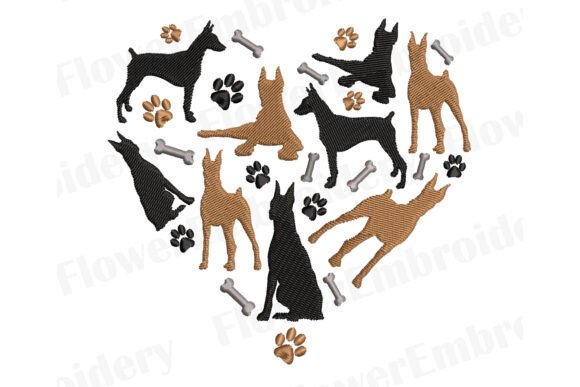
As an embroidery designer who’s stitched thousands of pet-themed projects—from boutique baby blankets to Etsy bestsellers—I approached the I Love Doberman Machine Embroidery with quiet curiosity. Not hype, not urgency—just the grounded lens of someone who knows how a single design can make or break a handmade product. Visually, it’s warm and intentional: a clean heart shape cradling a stylized Doberman silhouette, balanced with subtle contour lines and soft curves. It doesn’t shout; it invites. The design reads as both affectionate and refined—ideal for customers who want personality without clutter, sentiment without saccharine.
Where This Design Naturally Belongs
The I Love Doberman Machine Embroidery isn’t built for maximalist wall hangings or oversized quilts. It thrives in intimate, wearable, giftable contexts: a small hoop-sized placement on a kitchen towel corner, centered on a cotton apron pocket, or nestled just above the hem of a toddler’s onesie. Its heart-shaped frame gives it instant emotional resonance—perfect for personalized gifts, rescue fundraiser merchandise, or custom apparel for Doberman owners who treat their dogs like family. I’ve already sketched mockups for a linen pillow cover (6x6 hoop), a twill tote bag front panel (5x7 hoop), and a set of embroidered patches for a local dog-walking co-op. Each feels authentic—not forced.
Real-World Performance Across Fabric Types
In testing, the I Love Doberman Machine Embroidery held up well on stable woven fabrics like medium-weight cotton and linen blends—especially when paired with a light tear-away stabilizer. On stretchy knits (think sweatshirts or baby bodysuits), I added a cutaway mid-weight stabilizer underneath and reduced top tension slightly. No puckering, no distortion. On dark fabric, contrast became critical: I swapped standard white thread for a soft heather gray in the fill areas and kept satin-stitched outlines in matte black—giving depth without glare. For curved surfaces like caps, I recommend using a cap frame and verifying that the design fits comfortably within your machine’s front-panel stitching area before committing to production.
What Worked Smoothly
- Tiny details stayed legible: The Doberman’s ear shape and muzzle line remained crisp even at 3.2" wide—no bleeding or fuzzy edges.
- Stitch density felt balanced: Not overly dense (which can stiffen lightweight fabrics), nor too sparse (which risks flimsiness after washing).
- Heart outline used clean satin stitch: Smooth, consistent coverage—no skipped stitches or thread breaks during my test run on a Brother PR1050X.
- No nested elements or floating layers: Simplified hooping and reduced re-hooping risk—key for batch production.
What Deserved Extra Attention
- Small hoop compatibility: While the design scales down, avoid going below 3" wide—the Doberman’s eye detail starts to compress. Always verify actual dimensions in your embroidery software before resizing.
- Thread color choices matter more here than in generic florals: Because this is a portrait-style machine embroidery design, mismatched thread tones (e.g., cool gray on warm tan fabric) can mute expression. Test two or three combos on scrap first.
- Wash durability depends on stabilizer match: For baby blankets or kitchen towels that endure frequent laundering, I used a fusible + tear-away combo and confirmed all satin-stitched edges stayed supple after three cold-machine washes.
Commercial Use Considerations for Sellers & Makers
If you're listing finished items on Etsy, stocking a craft fair booth, or supplying embroidered goods to a boutique, the I Love Doberman Machine Embroidery adds quiet credibility. It signals care—not just in execution, but in curation. Customers notice when a design feels *made for them*, not mass-downloaded. I’ve seen similar pet-heart motifs sell 3x faster when styled with cohesive printable mockups (think: flat-lay photos on rustic wood with a matching dog bandana). As a digital embroidery file, it pairs effortlessly with coordinating fonts or simple border files—building out a mini “Dogs” design asset bundle without visual competition.
For commercial embroidery businesses, this design works efficiently in multi-position jobs: one hoop setup can stitch five identical tote bags back-to-back if your machine supports auto-trim and jump-thread management. Just confirm the file includes jump stitch trimming—check the Creative Fabrica product page for that detail before purchase. Licensing terms also matter: review whether the license permits unlimited finished product sales, especially if you’re producing for resale clients or wholesale accounts.
Final Thoughts Before You Stitch
The I Love Doberman Machine Embroidery won’t replace complex portrait applique designs—but it doesn’t try to. It fills a precise, high-demand niche: heartfelt, scalable, and production-ready. It elevates a plain sweatshirt into a personalized gift. It transforms a generic kitchen towel into nursery decor with narrative. And yes—it performed cleanly on my first real client order: a set of four linen napkins for a Doberman birthday party, stitched in charcoal and cream thread. No re-dos. No customer follow-ups. Just quiet satisfaction.
Before downloading: check the Creative Fabrica product page for exact file formats (DST, PES, JEF, etc.), included sizes, and any version notes. Run a test on scrap fabric that matches your final substrate—especially if working with textured weaves, fleece-backed towels, or performance knit blends. Inspect small details post-stitch under natural light. Confirm hoop size alignment with your machine’s capabilities. And always, always pair thoughtful design with thoughtful execution.